Thank you very much to Katie Moore for this great post on Tips for New Mothers. I can say from personal experience, I fully agree! Take a look through my recipes on this blog for easy, healthy meals for someone to make for you.
The biggest question a woman will ask herself after delivering a first child is, “Does motherhood
come with instructions?” Although this is a common fear among many new mothers, there are a
few tricks out there to make the transition into motherhood less stressful.
Once a new mother arrives home with her sweet bundle of joy, she will quickly learn that the
baby will only sleep for short periods of time. Since most newborns will sleep in two-hour
intervals, it is recommended to sleep when the baby sleeps. The tiny size of the newborn’s
stomach requires them to eat more often, causing them to only sleep in shorter bursts of time.
As their bellies grow, so does their ability to go longer without food.
Many mothers will face the emotional effects of delivering a baby after returning home. “Baby
blues”, sadness felt after having a baby, are common feelings but it is important for a new
mother to be able to identify the difference between normal post-delivery emotions and post-
partum depression. If a mother’s feeling of weepiness develops into more serious emotions,
consulting a doctor is the first step.
Learning the art of swaddling is a great tool to have for a new mother. Babies under the age
of four months, enjoy the security and boundaries that are found in a womb-like swaddle.
Swaddling will not only assist in helping baby to fall asleep, but will also keep them from waking
themselves up from involuntary spastic movements. Hospital nurses are swaddling pros and will
gladly offer a quick training session to curious new moms.
Keeping all items needed for late night feedings and diaper changes handy can make life easier
for a sleep-deprived mom. Waking up every few hours those first few months will leave a mother
feeling worn out. By having evening items handy, a new mom can quickly care for the baby and
return to sleep to catch up on her sleep.
When babies are in utero they are soothed by the sounds of the mother’s body like as her
heartbeat, muffled voice, and even her breathing. Noise machines are excellent alternatives to
mimic these sounds and place near, never inside, the baby’s crib. Hearing a heartbeat will make
a swaddled baby feel like he is back in the womb and will rest better for it.
New mothers often have running lists going on in their heads as they prepare for their first child.
By organizing these thoughts before delivery, new moms can keep themselves more organized.
There are even some important things that new parents may not consider, such as health
insurance coverage for the infant and umbilical cord blood banking. The first thirty days of a
newborn’s life will be covered by the mother’s health insurance plan; however the infant must be
added to the health insurance policy within thirty days of birth; otherwise some families will have
to wait until the next enrollment period.
Overall, the transition into motherhood can be a challenging experience. Yet with a little
planning and by remembering some of these helpful tips, the joys of motherhood are sure to be
rewarding.
"This article was written by Katie Moore. Katie is an active writer within the blogging community who discusses maternity, motherhood, prenatal health, childbirth and other topics within this niche.
If you have any questions or would like to connect with Katie please contact by visiting her blog, Moore From Katie or her twitter @moorekm26."
Wednesday, May 30, 2012
Tuesday, May 1, 2012
Black bean, corn and arugula salad
Summer is coming and fresh vegetables will be plentiful. Try this delicious salad as a side dish or even a main. It's light and satisfying.
Use the ingredients list as a guide. If you don't have peppers, use what is on hand. If you don't like cilantro, it's fine not to use it at all; many people don't like it. Use any lettuce, even finely sliced cabbage. See the tip below for how to make your red onion a little more mellow. Enjoy!
Black Bean, Corn and Arugula Salad
SALAD INGREDIENTS
1/4 medium red onion, diced or sliced
1/2 cup pepidas (pumpkin seeds), toasted
2-3 cups arugula, washed
1 15 ounce can black beans, drained and rinsed
1 cup corn, fresh or frozen (and thawed)
1/2 - 1 ripe avocado, sliced
1/2 red bell pepper, diced
1/2 yellow pepper, diced
1 tomato, quartered
1-2 tablespoons cilantro, chopped
1/2 cup crumbled feta, cojita or 1/4 cup parmesan cheese
DRESSING
2 teaspoons apple cider vinegar
1-2 tablespoons safflower or sunflower oil
1/2 teaspoon kosher salt
Fresh ground pepper
Juice from 1/2 lime
Optional: 1 teaspoon honey or agave nectar*
Soak onion in ice water in a small bowl for 5 minutes. Drain.
Toast pumpkin seeds in a small saute pan without any oil. Cool.
Add salad ingredients in a large bowl and toss. Pour dressing ingredients into bowl and toss. Serve immediately.
*My kids aren't big fans of arugula...yet. For them, I would make this salad with spinach or romaine, put in their favorite veggies and add the little bit of sweet (honey or agave) to round out the acid from the vinegar and the lime. I have found that most kids like a little this in their salad which is ok by me!
Friday, April 20, 2012
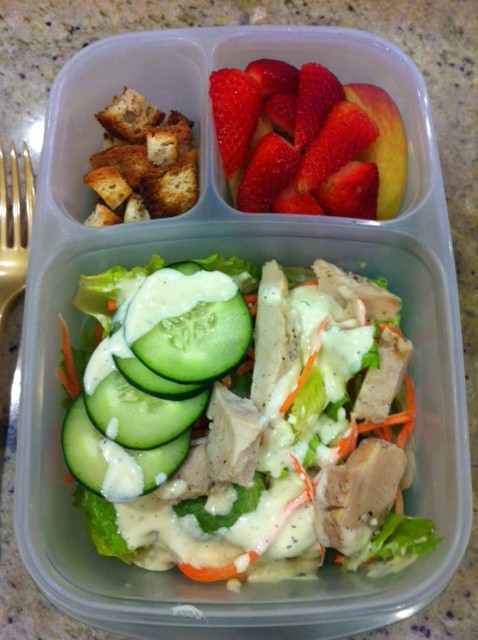
Gluten free and dairy free Caesar salad dressing recipe
Think outside the sandwich with Caesar salad!
I usually make this dressing with Parmesan cheese but have had a few people request a dairy-free version. I adapted this recipe, which is a fan favorite, by eliminating the cheese and adding the Dijon mustard. In my opinion, it’s almost identical. My family gave it the double thumbs up! If you want really traditional, you can top it with anchovies (a bit too fishy/salty for our tastes, though).
The recipes below give you an option of that beloved crunch and the creaminess you get from a restaurant Caesar salad without the use of wheat or dairy. I make the dressing with regular mayonnaise, which is made from egg and naturally dairy free, and the croutons I prepare from gluten-free sliced bread or baguette. With a few key ingredients on hand you’ll be surprised how easy it is to prepare!
Dairy-Free Caesar Salad Dressing (or dip)
1-2 garlic cloves, cut into 4-6 pieces
1/2 cup regular mayonnaise
3 tablespoons olive oil
1 1/2 teaspoons kosher salt or 1 teaspoon table salt
2-3 tablespoons fresh lemon juice
1/4 teaspoon ground pepper
1/2 teaspoon Dijon mustard
Place all ingredients in a small food processor and blend for 1-2 minutes. Keep refrigerated until ready to use. Toss with crisp, romaine lettuce pieces, cucumber slices and shredded carrots. Optionally add 2-3 ounces of grilled chicken per person.
Gluten-Free Croutons
½ loaf gluten-free baguette bread, cubed, or about 6 slices gluten-free bread cut into cubes
2-3 tablespoons olive oil
1/2 teaspoon kosher or sea salt
1/4 teaspoon each ground black pepper, oregano, and thyme
Toss bread with olive oil and seasonings. Place on a baking sheet. Bake in a 400F oven until brown and crisp. Store covered at room temperature.
Wednesday, March 28, 2012
Green smoothies: The new fun way to drink your veggies!

Thank you to Hilary Greenleaf for the complimentary e-book for use in this review.
Author Hilary Greenleaf brings new meaning to the idea of drinking your troubles away. She asked me if I’d review her latest book, The New Green Smoothie Diet, and I must say Greenleaf really pours on advice and nutritious recipes in a pretty digestible 35-page read. Available in both hard copy and e-book form, Greenleaf writes that the key to her green smoothies is combining fruits and vegetables in a respective 60 to 40 percent ratio so you can get the benefits of each while avoiding the often-bitter taste of raw vegetables. She offers information on maintaining good, general health as well as tips and recipes for specific interests ranging from hair care to cancer prevention. Trying to lose weight? Trim off a few pounds with the help of a Blackberry Lettuce Smoothie. Want to ward off that nasty cold that’s been going around? Then The Mighty Citrus Smoothie should do the trick.
The handy thing about smoothies is that it’s so simple (and fun!) to pack in a ton of colorful nutrition in such a condensed space. Many fruits and vegetables give us vitamins A and C, plenty of fiber and countless antioxidants and other disease-fighting benefits. If your kids turn their nose up at raw kale maybe they wouldn’t mind drinking a naturally sweetened version in a fun cup or pretty glass. For example, I think most kids will be delighted with the mauve color of the Energy Booster Smoothie and will likely not notice the spinach flavor so much.
As long as you’re not expecting Jamba Juice, you should be quite satisfied with the natural sweetness level of these smoothies. For kids, Greenleaf recommends upping the fruit portion to 70 percent until they get used to the flavor. You can also sweeten the concoction with natural, fruit-sugar containing mango or pineapple or by squirting in some citrus juice. Greenleaf actually discourages the use of fruits that naturally contain a lot of sugar, but if a little orange or mango juice helps my kids swallow their leafy greens, I’m pretty happy!
Sunday, March 11, 2012
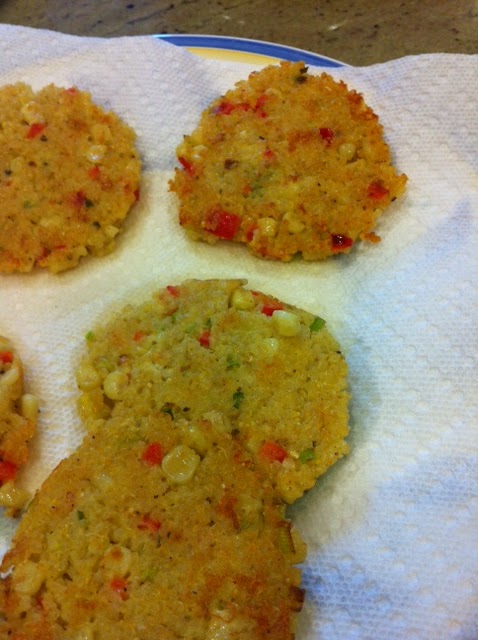
Quinoa and corn cakes recipe
I'm going to really try to not tell a super long story so you can get right to this recipe. Promise.
A friend of mine brought me one of these a few weeks ago; she had just made a batch and I was very excited to try them. I pictured it being more like a crab cake when she described it but it was closer to a griddle cake since it's flat.
My 6 year old daughter was in the room when she arrived with the sample. I'm thinking, "Oh yeah, it's doesn't have sugar. My daughter won't want this." Wrong.
"What's that, Mama?" she asked.
"Something with quinoa; I don't think you'll like it." (it smelled so good, I really did not want to share this).
"Can I have some?"
"Sure honey" and I gave her a piece.
"Uhmm, that's good!" she says "Can I have more?". At least she has good manners.
"Of course, you can. I'll give you half." but inside I was like, really? You want this? Woe is me. Never assume what your kids will and won't eat. I think I said that.
So, I got the recipe from my friend. It had come from her sister who had gotten it from a magazine in Southern California so I don't know the exact source. I did change some of the amounts and ingredients as well. If I find out where it came from, I will update the post.
I made the quinoa cakes the next week. Surprisingly, everyone (8 year old son and husband included) loved them. What a great way to get some healthy protein for us all! I hope you will give it a try.
Quinoa and Corn Cakes
Makes about 10-12
1/2 cup quinoa
1/2 cup water
1/2 cup chicken or vegetable broth (you can also use all water or broth)
1 large egg
1/2 cup corn (if using frozen, thaw slightly before adding or add to cooked quinoa)
2 scallions, finely chopped (white and green)
1/3 cup red pepper, diced
1/4 cup shredded mozzarella (optional)
1/4 cup The Family Chef's gluten-free flour blend (or all-purpose flour for non gluten-free)
2 tablespoons corn flour (the fine type, not coarse like polenta)
2 tablespoons milk or milk substitute
1/4 teaspoon Kosher salt
1/8 teaspoon ground pepper
Vegetable oil for frying
1. Cook quinoa. If quinoa has not been pre-rinsed (check package), rinse briefly under cold water. Add quinoa, water and broth to a small to medium sized pot with a pinch of salt. Bring to a boil, lower to a simmer and cover. Cook 10-12 minutes or until all of the water has absorbed. Cool slightly.
2. In a medium bowl, add egg and beat. Add remaining ingredients including quinoa but not the vegetable oil and mix with a spoon or rubber spatula/scraper. If mixture is very wet and won't hold together, add another tablespoon of the flour mixture.
3. Place a thin layer of vegetable oil in a medium to large non-stick pan. Heat pan to medium. When pan is hot, add 1/4 cup of the quinoa mixture and press down with a spatula to make a griddle cake. Make sure to leave room between each one. Cook about 2-3 minutes or until one side is golden brown. Flip over and cook the other side. They don't always stay together perfectly but that's ok; they taste great.
4. Serve cakes immediately or at room temperature, plain or with a tomato salsa.
A friend of mine brought me one of these a few weeks ago; she had just made a batch and I was very excited to try them. I pictured it being more like a crab cake when she described it but it was closer to a griddle cake since it's flat.
My 6 year old daughter was in the room when she arrived with the sample. I'm thinking, "Oh yeah, it's doesn't have sugar. My daughter won't want this." Wrong.
"What's that, Mama?" she asked.
"Something with quinoa; I don't think you'll like it." (it smelled so good, I really did not want to share this).
"Can I have some?"
"Sure honey" and I gave her a piece.
"Uhmm, that's good!" she says "Can I have more?". At least she has good manners.
"Of course, you can. I'll give you half." but inside I was like, really? You want this? Woe is me. Never assume what your kids will and won't eat. I think I said that.
So, I got the recipe from my friend. It had come from her sister who had gotten it from a magazine in Southern California so I don't know the exact source. I did change some of the amounts and ingredients as well. If I find out where it came from, I will update the post.
I made the quinoa cakes the next week. Surprisingly, everyone (8 year old son and husband included) loved them. What a great way to get some healthy protein for us all! I hope you will give it a try.
Quinoa and Corn Cakes
Makes about 10-12
1/2 cup quinoa
1/2 cup water
1/2 cup chicken or vegetable broth (you can also use all water or broth)
1 large egg
1/2 cup corn (if using frozen, thaw slightly before adding or add to cooked quinoa)
2 scallions, finely chopped (white and green)
1/3 cup red pepper, diced
1/4 cup shredded mozzarella (optional)
1/4 cup The Family Chef's gluten-free flour blend (or all-purpose flour for non gluten-free)
2 tablespoons corn flour (the fine type, not coarse like polenta)
2 tablespoons milk or milk substitute
1/4 teaspoon Kosher salt
1/8 teaspoon ground pepper
Vegetable oil for frying
1. Cook quinoa. If quinoa has not been pre-rinsed (check package), rinse briefly under cold water. Add quinoa, water and broth to a small to medium sized pot with a pinch of salt. Bring to a boil, lower to a simmer and cover. Cook 10-12 minutes or until all of the water has absorbed. Cool slightly.
2. In a medium bowl, add egg and beat. Add remaining ingredients including quinoa but not the vegetable oil and mix with a spoon or rubber spatula/scraper. If mixture is very wet and won't hold together, add another tablespoon of the flour mixture.
3. Place a thin layer of vegetable oil in a medium to large non-stick pan. Heat pan to medium. When pan is hot, add 1/4 cup of the quinoa mixture and press down with a spatula to make a griddle cake. Make sure to leave room between each one. Cook about 2-3 minutes or until one side is golden brown. Flip over and cook the other side. They don't always stay together perfectly but that's ok; they taste great.
4. Serve cakes immediately or at room temperature, plain or with a tomato salsa.
Tuesday, March 6, 2012
Vegetable and bean soup recipe
One thing I'm good at is looking in the fridge and seeing a meal I can create. One friend said to me once "You look at a cucumber and see 5 ways you can use it. I look at it and see a cucumber." Well, that's why I'm here!
On this particular night, I had lots of veggies in the fridge, a few cans of beans, and a can of diced tomatoes. I always keep gluten-free pasta and chicken broth on hand so to me, that said soup. I cut up the onions, carrots and celery and sauteed them while I opened the cans of beans and diced some other veggies. In well under an hour, dinner was served much to the delight of my family on a chilly night. To learn how to make soup, check this blog entry.
Don't think healthy cooking has to be complicated; it doesn't. But you do need to keep a few things around. My go-to items for soups are:
- Onion, carrot and celery
- Chicken or vegetable broth
- Beans like garbanzo, black, kidney and cannellini or great northern white
You can always add other ingredients like vegetables, diced tomatoes, lentils or split peas, pasta or grains. Salt is essential for flavor along with some seasoning. The basic steps are:
1) Saute the onions, carrot and celery with seasonings.
2) Add broth, beans and any other liquid ingredients (for example, diced tomatoes) and simmer about 20-30 minutes.
3) You can cook pasta, grains or rice in the soup as long as there is enough liquid. Cook based on the amount of time it takes to cook the item (10 minutes for pasta, 20 minutes for rice, etc.).
4) Add fresh vegetables like broccoli, beans or cauliflower during the last 5 minutes of cooking. Other harder veggies like sweet potatoes need longer to cook. Add them before.
5) Taste at the end to make sure there is enough salt.
I suppose you can call this a minestrone soup but I like to focus on the extra veggies. Try this any night of the week. I think your family will love it and you!
Vegetable and Bean Soup
Serves 4-6
2 teaspoons olive oil
1/2 onion, chopped
2 carrots, peeled and chopped
2 celery stalks, peeled and chopped
1/2 teaspoon each pepper, oregano, thyme
2 cloves chopped garlic (optional)
1/2 teaspoon salt
1 quart vegetable or chicken broth plus 2 cups water (omit water if if you aren’t cooking any grains, pasta or rice)
1 can garbanzo beans, drained and rinsed
1 can kidney beans, drained and rinsed
1 can white beans, drained and rinsed
1 15 oz can diced tomatoes, not drained
2 cups cooked or 1 cup dry small pasta like little ditalini, shells or elbows (I use gluten-free)
1-2 cups total assorted chopped vegetables like broccoli, cauliflower, string beans, zucchini, red pepper or kale
Toppings:
1/2 cup parmesan cheese
2-3 Tablespoons pesto
1. Heat large soup pot to medium first. Add oil, then onion, carrot, celery, and seasonings. Stir once and cook, stirring only occasionally, making sure vegetables don’t burn but that they are browning. Continue cooking until the vegetables are golden and softened.
2. Add garlic and salt and cook for 1 minute.
3. Add broth, water, all of the beans, and diced tomatoes. Simmer 20 minutes uncovered.
4. Add dry pasta, rice or grain to the soup and cook until done (base additional cooking time on how long the item takes).
5. Add additional veggies and cook another 3-5 minutes or until the veggies are soft.
6. Top each bowl with grated Italian cheese and/or pesto. Enjoy!
Saturday, February 18, 2012
Gluten-free Fruit and Berry Crisp Recipe
This recipe is so good, you will also want seconds!
What I love about this recipe is that you can make it all year round. In the summer, there is a bounty of fruit like peaches, apricots, nectarines, and all types of berries. In the winter, you can use apples, pears, and frozen fruit. The recipe is very forgiving as well. You can measure the fruit or just put enough to fill your pan. Use what's on hand and check the freezer.
I love using berries in my crisp recipe because they are so healthy. We are lucky to have Driscoll's Berries available in stores where I shop. I like that they are just down the road in Watsonville, produce tasty berries and offer a wide variety of organic products. For the crisp above, I used raspberries, blueberries, frozen peaches and fresh apple slices.
Remember, berries freeze very well so get them when they are fresh from the market, lay them flat on a cookie sheet, freeze, then transfer to a freezer-safe bag or container. The bag is a little better because you can remove the air which can cause freezer burn. If you wash your berries, make sure they are dry before freezing. I give mine a quick rinse and gently pat them with a paper towel to avoid breaking them.
I have been making this fruit crisp for a long time. When I went gluten-free, I adapted it so the whole family could enjoy it. It continues to be a favorite of my family, friends and students in my classes. It can be served as is, with ice cream or heavy cream, yogurt or, for a dairy-free ice cream, try some vanilla coconut "ice cream".
If you are concerned about the oats (some people can't even tolerate the gluten-free variety), add more gluten-free flour mix and chopped nuts. To save time, measure the crisp ingredients (except the butter) beforehand and keep it in a bowl until you are ready to bake. Instead of a store-bought dessert, why not give this one a try? I'll bet everyone will appreciate it!
Watch the how-to video here on The Family Chef You Tube channel.
Gluten-Free Fruit and Berry Crisp
1/2 cup Amy's gluten-free flour mix
1/3 cup gluten-free quick oats (if you can’t tolerate oats, substitute with more gluten-free flour mix and/or more chopped nuts)
1/3 cup organic white or cane sugar
1/2 teaspoon Kosher salt (use 1/4 teaspoon of table salt)
Optional: 1/2 cup chopped nuts (chop first, then measure)
6-8 Tablespoons melted unsalted butter or vegetable oil (use less if you are watching calories; more if you want a crisper topping)
Filling:
4 cups sliced, peeled and cored fruit like apples, pears, peaches, nectarines and/or blueberries, blackberries or olallieberries (use all of one or a combination)
1/3 – 1/2 cup sugar or agave nectar (use more sugar or agave if the fruit is tart or if you use more than 4 cups)
2 Tablespoons cornstarch or any other starch like tapioca or arrowroot
1. Preheat the oven to 375F. Grease a 2 to 2-1/2 quart baking dish or deep pie dish.
2. Make the Crisp Topping and set aside.
3. Mix the fruit, sugar and cornstarch and toss gently. Transfer the fruit mixture to the baking dish and cover with the crisp topping, spreading evenly.
4. Place in the oven and bake until the top is well browned and the fruit is tender when pierced with a knife, about 30-35 minutes.
5. Serve with whipped cream or ice cream.
Subscribe to:
Posts (Atom)