Anyone can be "the family chef". You just need good recipes and techniques! Chef Amy Fothergill shares her best recipes with you for quick and easy dishes with an emphasis on gluten-free.

Get information here about her cookbook, The Warm Kitchen: Gluten-Free Recipes Anyone Can Make and Everyone Will Love.
Showing posts with label healthy eating. Show all posts

Thursday, July 18, 2013

Canyon Oats provides wholesome on-the-go breakfast alternative


We are all busy, whether or not you have a family. Breakfast can be one meal we skip or just grab something convenient which isn't always healthy.  Have you considered a cup of oatmeal? One wholesome breakfast alternative comes from Canyon Oats -- a family-owned business located in Powell, Wyoming.

The hot cereal got its start in a coffee shop and roaster in St. George, Utah and began with simple, whole ingredients: rolled oats, sea salt, cinnamon, and golden flax seed. The company soon expanded and began rolling in maple sugar, almonds, tart cherries, cranberries and walnuts. More wholesome ingredients packed in convenient, on-the-go style cups.

I brought some samples home from a gluten-free expo (thanks Canyon Oats!) and the consensus was "delicious" and "yummy."

Need another selling point? The company’s oatmeal products are gluten-free! Oats don’t contain gluten naturally, of course, but many commercial vendors produce their oatmeal in facilities that also manufacture wheat—producing enough of a contamination to potentially harm a consumer who has severe gluten sensitivity.

The cups are sold across the country at select coffee shops. Check out the company’s website for purchase locations or to order the product online. Might be a good option on your next busy morning.

Monday, May 13, 2013

Real Simple Delicious Soup Review


 Thank you to Real Simple Delicious for providing product samples for my review.

When you’re craving a nice, comforting bowl of soup but aren’t prepared to make it from scratch, there are other options besides resorting to a can. One refreshing example is the Real Simple Delicious line of soups from Cook! These tasty, gluten and dairy-free blends come in the refrigerated section of select grocery stores but can be frozen for longer shelf life.  Flavors include Thai Green Curry, All Bean Chili, Zucchini, Red Lentil, French Onion, Carrot Ginger and Azteca Veggie.

The company—launched in the San Francisco Bay Area just a few years ago—operates under the philosophy that quality and convenience can go hand in hand.

The soups are perfect for those hectic nights when you’re scrounging for a quick dinner the whole family can enjoy. The soup also works well as a base for larger meals. I served the Thai Green Curry soup over chicken and rice and it turned out great (see photo below). The curry wasn’t too spicy (my husband wanted more spice but I thought it worked well) but do be aware that there is tofu in this particular soup in case you are allergic to soy.

The Azteca Veggie, was a tasty blend of carrots, onion, corn and tomato with a nice addition of summer-y squash. The soup ran a bit on the salty side but had a nice flavor.

The zucchini soup was also surprisingly flavorful as I was not expecting such complexity from just garlic, onions and a touch of mild chile. I would definitely get this one again and consider it family friendly. I had some leftover pasta so I added that to mix and it worked well. You could put almost anything in it. It was very tasty.

With special emphasis on avoiding toxins and allergens in our diets, Cook! delivers meal plans and ready to eat dishes to households nationwide.  The soups, however, are available at various health food stores including Whole Foods, Real Food Company and Rainbow Grocery (see website for complete list).

Real Simple Delicious will be changing their name to Nona Lim. Get the story here. You can also follow them on Facebook.

Either way, it's easy, fresh, tasty, and healthy… the soup’s on!

Thursday, March 14, 2013

Healthy Lunch Challenge


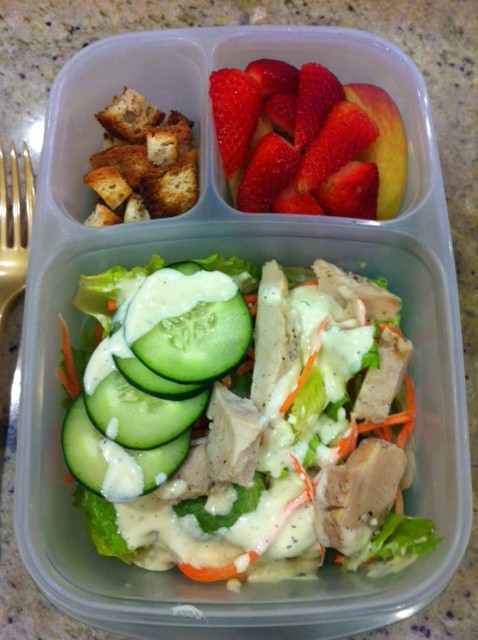
When I was asked to create an example of a healthy gluten-free lunch for the ladies of Easy Lunch Boxes and Crunch a Color, I jumped at the chance. It was easy for me because this is what I (try to) do 5 days a week.

I have been using Kelly Lester's Easy Lunch Boxes (ELB) since 2010 (see my review here). I still have the original containers and only now have to replace one of the lunch bags; it’s gotten a lot of use! I find them very convenient and easy to use. The bag fits either two ELB plastic containers or an ELB container, a metal container (if needed) and a thermos for hot food. When we get home from school, my kids help by putting the containers and/or thermos in the dishwasher. I even have a special place on the top rack where they fit perfectly.

I think the Crunch a Color game is great. If you have picky eaters who don’t like to try new things, this might be the solution. The game is meant to make healthy eating fun. We have all had our challenges getting our kids to eat a well balanced meal. I love that Jennifer Lee and I share many things in common including children of similar age and dealing with some times opinionated eaters (that's a nicer way to say it, isn't it?). We even got together to put on a "Healthy Cooking Tips for Busy Moms" cooking class to benefit Jamie Oliver's Food Revolution.

So, what was for lunch? Just a few of my favorite things. Believe it or not, my kids love Caesar salad. They will order it almost every time we are out (hold the croutons, though) so this is one of my go-to lunch meals. I make my Easy Caesar Dressing and keep it in the fridge for a few weeks (get the dairy-free version here). This way, it’s easy to grab whenever I need it. I will add other veggies like shredded carrots, cooked broccoli or cucumbers, depending upon what’s in the fridge. The croutons are simply Udi's gluten-free whole grain bread which are cut into cubes, oiled and seasoned and toasted until golden brown.

I have a new favorite chicken recipe which uses Just Cook Food’s (a local San Francisco company) Herbed Coffee rub. For every pound of boneless skinless chicken thighs, I add 1 teaspoon each of the coffee rub and olive oil. I stir it around and let it marinate for about 20 minutes. Then it’s onto the grill for about 10-15 minutes. You can also bake it on a tray in a 400F oven for about 15 minutes. Since this dish works well, I usually make 2-3 pounds and then use it for 1-2 other meals besides lunches. You would not believe how much my 9 year old son eats!

Lastly, the "dessert" is one of my homemade gluten and dairy-free blueberry muffins. Making muffins and quick breads dairy-free is actually quite easy; substitute vegetable oil for the butter and any alternative milk (like soy, almond, or coconut) for the milk. No problem! If you don't have dairy restrictions, simply use the regular version.

I used the Crunch a Color cards to see how I did for this lunch. Based on the numbers, I think I did pretty well! I hope this post inspires you to change it up for your lunch. Thank you, ladies, for including me in your challenge!

Wednesday, December 12, 2012

Farmigo brings Farmer's Markets to you


Would you be interested in a company which brings delicious farm-fresh foods to families but also benefits farmers?  Farmigo has the potential to change the way San Francisco families eat.

The first online farmer’s market has been launched as of December 11 to connect communities (such as workplaces, schools and community centers) directly to complementary local farms to provide “food community” members with an online marketplace for local, fresh-from-harvest food. They have kicked off in a handful of markets, and the Bay Area is one of them. (Get a look at what they are doing in Brooklyn here).

Once the food community site is established, it will be matched with complementary local farms that offer seasonal fruits, vegetables, eggs, meats, cheeses (even wine and coffee in some locations) that was harvested within 48 hours of delivery and has traveled less than 100 miles.

The farms drop off the orders at the site at the same time each week and members can come by to collect their fresh produce. It’s a great way to bring communities together over food, and Farmigo even helps organize events for all the new communities.

Farmigo recognized there were many awesome, passionate people in the Bay Area, not just San Francisco, who want to bring fresh food to their communities.  Food sites can be organized at almost anywhere that a group of people can get together, etc. Anyone who is interested in a Farmigo food community can sign up on as of today. Leave a comment and let me know what you think.


Tuesday, October 9, 2012

Roasted Red Cabbage


This is in the category of "things you should not assume your kids won't like". A friend of mine (thank you Kristen!) served it at dinner a few years ago and I was amazed that my then 5 year old daughter loved it. I really was shocked! However, my then 7 year old ate it but I'm not sure he loved it. I'm okay with that.

There's really no recipe; it's more of a method. Here you go:
Preheat oven to 375F. If you have convection, use it for this dish.
I use about 1/2 of a cabbage for our family of 4. Many grocery stores will cut a cabbage in half for you if you don't think you will use the rest.
Remove the white core from the middle. Cut the cabbage into wedges. 
Drizzle with olive oil. Season with salt and pepper. 
Roast about 12-15 minutes or until you can smell the cabbage. Cabbage should be tender with a little browning. Serve as is.

Tuesday, May 1, 2012

Black bean, corn and arugula salad


Summer is coming and fresh vegetables will be plentiful. Try this delicious salad as a side dish or even a main. It's light and satisfying.

Use the ingredients list as a guide. If you don't have peppers, use what is on hand. If you don't like cilantro, it's fine not to use it at all; many people don't like it. Use any lettuce, even finely sliced cabbage. See the tip below for how to make your red onion a little more mellow. Enjoy!

Black Bean, Corn and Arugula Salad


SALAD INGREDIENTS
1/4 medium red onion, diced or sliced
1/2 cup pepidas (pumpkin seeds), toasted
2-3 cups arugula, washed
1 15 ounce can black beans, drained and rinsed
1 cup corn, fresh or frozen (and thawed)
1/2 - 1 ripe avocado, sliced
1/2 red bell pepper, diced
1/2 yellow pepper, diced
1 tomato, quartered
1-2 tablespoons cilantro, chopped
1/2 cup crumbled feta, cojita or 1/4 cup parmesan cheese

DRESSING
2 teaspoons apple cider vinegar
1-2 tablespoons safflower or sunflower oil
1/2 teaspoon kosher salt
Fresh ground pepper
Juice from 1/2 lime
Optional: 1 teaspoon honey or agave nectar*

Soak onion in ice water in a small bowl for 5 minutes. Drain.

Toast pumpkin seeds in a small saute pan without any oil. Cool.

Add salad ingredients in a large bowl and toss. Pour dressing ingredients into bowl and toss. Serve immediately.

*My kids aren't big fans of arugula...yet. For them, I would make this salad with spinach or romaine, put in their favorite veggies and add the little bit of sweet (honey or agave) to round out the acid from the vinegar and the lime. I have found that most kids like a little this in their salad which is ok by me!

Friday, April 20, 2012

Gluten free and dairy free Caesar salad dressing recipe


Think outside the sandwich with Caesar salad!

Running out of gluten-free and dairy-free lunch ideas for your kids’ lunchboxes? This can be a particular challenge when most traditional options revolve around bread and cheese. Of course you can always use gluten-free bread to make the traditional turkey or peanut butter and jelly, but why not think outside the standard lunch box fare and prepare a fresh salad? Children are often big fans of Caesar salad for the creamy dressing, pleasantly non-bitter romaine lettuce and the crunchy croutons. I love to use Easy Lunchboxes since it’s easy to keep everything separated; the croutons would be a bit mushy if I put them on in the morning!

I usually make this dressing with Parmesan cheese but have had a few people request a dairy-free version. I adapted this recipe, which is a fan favorite, by eliminating the cheese and adding the Dijon mustard. In my opinion, it’s almost identical. My family gave it the double thumbs up! If you want really traditional, you can top it with anchovies (a bit too fishy/salty for our tastes, though).

The recipes below give you an option of that beloved crunch and the creaminess you get from a restaurant Caesar salad without the use of wheat or dairy. I make the dressing with regular mayonnaise, which is made from egg and naturally dairy free, and the croutons I prepare from gluten-free sliced bread or baguette. With a few key ingredients on hand you’ll be surprised how easy it is to prepare!

Dairy-Free Caesar Salad Dressing (or dip)
1-2 garlic cloves, cut into 4-6 pieces
1/2 cup regular mayonnaise
3 tablespoons olive oil
1 1/2 teaspoons kosher salt or 1 teaspoon table salt
2-3 tablespoons fresh lemon juice
1/4 teaspoon ground pepper
1/2 teaspoon Dijon mustard

Place all ingredients in a small food processor and blend for 1-2 minutes. Keep refrigerated until ready to use. Toss with crisp, romaine lettuce pieces, cucumber slices and shredded carrots. Optionally add 2-3 ounces of grilled chicken per person.

Gluten-Free Croutons
½ loaf gluten-free baguette bread, cubed, or about 6 slices gluten-free bread cut into cubes
2-3 tablespoons olive oil
1/2 teaspoon kosher or sea salt
1/4 teaspoon each ground black pepper, oregano, and thyme

Toss bread with olive oil and seasonings. Place on a baking sheet. Bake in a 400F oven until brown and crisp. Store covered at room temperature.

Caesar salad

Sunday, March 11, 2012

Quinoa and corn cakes recipe

I'm going to really try to not tell a super long story so you can get right to this recipe. Promise.

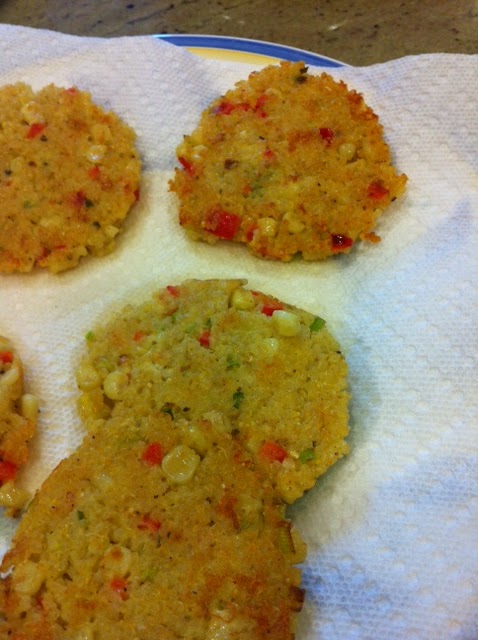
A friend of mine brought me one of these a few weeks ago; she had just made a batch and I was very excited to try them. I pictured it being more like a crab cake when she described it but it was closer to a griddle cake since it's flat.

My 6 year old daughter was in the room when she arrived with the sample. I'm thinking, "Oh yeah, it's doesn't have sugar. My daughter won't want this." Wrong.
"What's that, Mama?" she asked.
"Something with quinoa; I don't think you'll like it." (it smelled so good, I really did not want to share this).
"Can I have some?"
"Sure honey" and I gave her a piece.
"Uhmm, that's good!" she says "Can I have more?". At least she has good manners.
"Of course, you can. I'll give you half." but inside I was like, really? You want this? Woe is me. Never assume what your kids will and won't eat. I think I said that.

So, I got the recipe from my friend. It had come from her sister who had gotten it from a magazine in Southern California so I don't know the exact source. I did change some of the amounts and ingredients as well. If I find out where it came from, I will update the post.

I made the quinoa cakes the next week. Surprisingly, everyone (8 year old son and husband included) loved them. What a great way to get some healthy protein for us all! I hope you will give it a try.

Quinoa and Corn Cakes
Makes about 10-12

1/2 cup quinoa
1/2 cup water
1/2 cup chicken or vegetable broth (you can also use all water or broth)
1 large egg
1/2 cup corn (if using frozen, thaw slightly before adding or add to cooked quinoa)
2 scallions, finely chopped (white and green)
1/3 cup red pepper, diced
1/4 cup shredded mozzarella (optional)
1/4 cup The Family Chef's gluten-free flour blend (or all-purpose flour for non gluten-free)
2 tablespoons corn flour (the fine type, not coarse like polenta)
2 tablespoons milk or milk substitute
1/4 teaspoon Kosher salt
1/8 teaspoon ground pepper

Vegetable oil for frying

1. Cook quinoa. If quinoa has not been pre-rinsed (check package), rinse briefly under cold water. Add quinoa, water and broth to a small to medium sized pot with a pinch of salt. Bring to a boil, lower to a simmer and cover. Cook 10-12 minutes or until all of the water has absorbed. Cool slightly.
2. In a medium bowl, add egg and beat. Add remaining ingredients including quinoa but not the vegetable oil and mix with a spoon or rubber spatula/scraper. If mixture is very wet and won't hold together, add another tablespoon of the flour mixture.
3. Place a thin layer of vegetable oil in a medium to large non-stick pan. Heat pan to medium. When pan is hot, add 1/4 cup of the quinoa mixture and press down with a spatula to make a griddle cake. Make sure to leave room between each one. Cook about 2-3 minutes or until one side is golden brown. Flip over and cook the other side. They don't always stay together perfectly but that's ok; they taste great.
4. Serve cakes immediately or at room temperature, plain or with a tomato salsa.

Tuesday, March 6, 2012

Vegetable and bean soup recipe


One thing I'm good at is looking in the fridge and seeing a meal I can create. One friend said to me once "You look at a cucumber and see 5 ways you can use it. I look at it and see a cucumber." Well, that's why I'm here!

On this particular night, I had lots of veggies in the fridge, a few cans of beans, and a can of diced tomatoes. I always keep gluten-free pasta and chicken broth on hand so to me, that said soup. I cut up the onions, carrots and celery and sauteed them while I opened the cans of beans and diced some other veggies. In well under an hour, dinner was served much to the delight of my family on a chilly night. To learn how to make soup, check this blog entry.

Don't think healthy cooking has to be complicated; it doesn't. But you do need to keep a few things around. My go-to items for soups are:
  • Onion, carrot and celery
  • Chicken or vegetable broth
  • Beans like garbanzo, black, kidney and cannellini or great northern white

You can always add other ingredients like vegetables, diced tomatoes, lentils or split peas, pasta or grains. Salt is essential for flavor along with some seasoning. The basic steps are:
1) Saute the onions, carrot and celery with seasonings.
2) Add broth, beans and any other liquid ingredients (for example, diced tomatoes) and simmer about 20-30 minutes.
3) You can cook pasta, grains or rice in the soup as long as there is enough liquid. Cook based on the amount of time it takes to cook the item (10 minutes for pasta, 20 minutes for rice, etc.).
4) Add fresh vegetables like broccoli, beans or cauliflower during the last 5 minutes of cooking. Other harder veggies like sweet potatoes need longer to cook. Add them before.
5) Taste at the end to make sure there is enough salt.

I suppose you can call this a minestrone soup but I like to focus on the extra veggies. Try this any night of the week. I think your family will love it and you!

Vegetable and Bean Soup
Serves 4-6

2 teaspoons olive oil
1/2 onion, chopped
2 carrots, peeled and chopped
2 celery stalks, peeled and chopped
1/2 teaspoon each pepper, oregano, thyme

2 cloves chopped garlic (optional)
1/2 teaspoon salt

1 quart vegetable or chicken broth plus 2 cups water (omit water if if you aren’t cooking any grains, pasta or rice)
1 can garbanzo beans, drained and rinsed
1 can kidney beans, drained and rinsed
1 can white beans, drained and rinsed
1 15 oz can diced tomatoes, not drained

2 cups cooked or 1 cup dry small pasta like little ditalini, shells or elbows (I use gluten-free)
1-2 cups total assorted chopped vegetables like broccoli, cauliflower, string beans, zucchini, red pepper or kale

Toppings:
1/2 cup parmesan cheese
2-3 Tablespoons pesto

1.    Heat large soup pot to medium first. Add oil, then onion, carrot, celery, and seasonings. Stir once and cook, stirring only occasionally, making sure vegetables don’t burn but that they are browning. Continue cooking until the vegetables are golden and softened.
2.    Add garlic and salt and cook for 1 minute.
3.    Add broth, water, all of the beans, and diced tomatoes. Simmer 20 minutes uncovered.
4.    Add dry pasta, rice or grain to the soup and cook until done (base additional cooking time on how long the item takes).
5.    Add additional veggies and cook another 3-5 minutes or until the veggies are soft.
6.    Top each bowl with grated Italian cheese and/or pesto. Enjoy!

Wednesday, September 7, 2011

What I learned about food and eating on my cleanse

I had an amazing experience this summer when I “cleansed” for 10 days. The reactions I received were interesting; some people thought I was going hard core, you know, like water with lemon and cayenne pepper with maybe some celery sticks for dinner. Many people were supportive. All I know is that I certainly felt I have gained some clarity (and lost some weight).

The Clean Program
Before I started, I read the book “Clean” by Dr. Alejandro Junger. A few friends I know had done it with great success. The cleanse itself is called “The Clean Program” in which you follow instructions given in the book. It’s important to read it first as it helps to understand why you aren’t eating certain food or what is happening to your body on a daily basis. Yes, I tried to fast forward to the end but that didn’t work! I think it’s great to do a cleanse if you are a good candidate (always check with your doctor) but I think what is most important, is what you get out of it afterward. Since I wasn’t cooking all of the time, I had more time to think. I learned that:

  • I don’t need caffeine, wine, sweets or even bread to live.
  • I was not drinking enough water, even though I thought I was. They suggest you pee every hour (well at least on the cleanse; I think I drink a lot but still don’t do that. Let me get another glass of water right now).
  • I could live if I was a little hungry and that I could function without a lot of food.
  • My own personal eating was often triggered by situations like “I’m near the coffee shop; I’ll get a coffee. I want to see a friend; I’ll suggest meeting for lunch. I’m at the Ferry Building; I need to get something to eat.”
  • Cooking food over 118F diminishes its nutritional value (oh, that’s why all of those people are into raw food!).
  • It is easiest to digest food in liquid form (hence the shakes and the juices).
  • For some people, the Clean Program cleanse changed their life. It’s one of the few times, after only 10 days, that I looked at food and people eating it, very differently.
  • My eating is in my control. It’s not my age or my activity level; it’s how much and what type of food I eat.
Healthy Eating
If you are reading this blog post and drinking a diet soda or eating something from a bag, stop and think about what you are really putting into your body. If you don’t think there is a connection between our health and what we eat, take a second, step back and really think about it. This cleanse made me do that. I’m not insisting you try this cleanse but I do think we all need to think about what and how much we eat, especially if you are trying to lose weight. So many people think they can’t do it (I’m too busy, I don’t like to cook, it’s too hard…) but most of it is within reach; in the produce section. Eating raw fruits, veggies, nuts and seeds has a huge impact for me. I used to think I had to eat a certain amount of food but was amazed at how I could function on so little.

Managing Hunger
Yes, I was hungry during the cleanse but I could still work, work-out, be a mom, friend and wife. I had energy and felt good. When I went back to eating regular food, I noticed how much I burped! Guess what I didn’t do on the cleanse? I found I was less hungry and more thirsty. When I was hungry, and it was in between meals, I had some carrots, cukes or a handful of berries or nuts. That really helped. Once I made it to about 5pm, I was fine. Well, except the night when I was at a client’s house and they were cooking steak. I truly felt like the shark in Finding Nemo who tasted the blood! But I made it through. The first week was easier than the second and in my work, by the second week, I had less discipline. All in all though, I felt I did okay.

Caffeine
Earlier in the summer, I had the unfortunate experience of coming down with strep throat. I was basically on a liquid diet for 5 days and did not want to drink coffee; I had tea instead. I found that this was a good test, not that it was intentional, that proved to me I didn’t need coffee. I just drank herbal teas. I would have a decaf chai which I flavored with almond milk and agave nectar or ginger lemon tea. I miss that now!

Juicing and Shakes
In order to aid digestion, two of your three meals are liquid. I usually had one shake and one juice. With my juice, I added some hemp powder. Hemp protein powder is its own whole food source. It has the optimal balance of the Omega 3 and Omega 6 Essential Fatty Acids and is also very rich in fiber, complete protein and branch chain amino acids. It’s green which may not look appetizing but can hardly be tasted. I’m still using it today. I loved shakes with berries for the antioxidant benefits and was able to switch to unsweetened almond and coconut milk pretty easily. Even now, I can have a shake at breakfast and feel full until lunch (as long as I have some water). If I am hungry, my snack might be some nuts and seeds.

One of the suggestions is to drink a vegetable and/or vegetable and fruit juice each day. I’m not talking about orange or something from Jamba Juice. This is the type where you have the special juicer (got my Jack LaLanne at Costco) and you push the veggies or fruit through a shredder to take out the juice. It leaves the pulp behind. After the cleanse, I watched a fascinating documentary called “Fat, Sick and Nearly Dead” where a man from Australia cures himself by drinking juices for 60 days. From the website, he is described as “100 pounds overweight, loaded up on steroids and suffering from a debilitating autoimmune disease, Joe Cross is at the end of his rope and the end of his hope.” He also helps an American truck driver, Phil Staples, to turn his life around. Phil loses over 200 pounds on the “reboot diet”; completely amazing. He is now an inspirational speaker. Maybe we just need fewer drugs and more juice?

Other Meals
Sometimes my meals were made up of a big salad or quinoa and beans but on other days, I got quite creative. I adapted one of the recipes in the book and made a roasted (i.e. baked) salmon which I served on wilted arugula and spinach with a cilantro pesto. Check this blog entry for the details. Because I was not eating as much, I noticed I didn’t spend as much time prepping. Since I was not able to eat “whatever I wanted”, even when I was home, I had more time. It was really quite fascinating.

I would say the bottom line is if you want to do a cleanse, always talk to a doctor first and make sure you are a good candidate. I called this cleanse “civilized” because I was able to eat some real food. Make sure to read the book first and don’t try to go to the end right away looking for the answers to the test. The stories and information are very interesting. When you step back and think about it, it all makes sense. Plan it in your calendar to make sure you have the time and that there aren’t too many social commitments which would make it difficult. I did mine right before a vacation and eased back into eating 2 days before. If you go off of program for a meal, just start back up the next day. I had to taste some food while cooking and couldn’t seem to resist movie popcorn I had gotten for my kids (but I still ate so much less than normal).

I talked to my brother about it and suggested he just read the book. He asked me “What are the big takeaways” to which I replied:
  • Eat a lot of raw food (fruits, vegetables, nuts and seeds)
  • Avoid or limit gluten, dairy, alcohol, caffeine and sugar
  • Drink a lot of water
  • Try to avoid or limit toxins in your food, drinks and environment
It’s not rocket science but it is a change of lifestyle. When I speak to clients, I explain to them that my healthy eating is not 100% perfect and it has taken me 8 years to eat better. I had some mojitos last night and I’m making carrot cake tonight. But, relative to who I was and how I ate in 2003, I feel like I’m on a good path that is working for me and my family. My husband even commented “I am ready to go back to gluten-free”. Yippee!

Tuesday, June 28, 2011

The meaning of LYFE (kitchen), opening in Palo Alto later this summer

 LYFE Kitchen's "Fork Lifting" event 
to celebrate the upcoming opening
of it's first restaurant in Palo Alto, CA


When a restaurant or brand describes their food as great-tasting that is also convenient, affordable and good for you, they have my attention. Well, they had it a great-tasting! I was invited to this event in June and want to report about this exciting venture that is about to start in our own backyard. I have borrowed some bits and pieces from their press releases. I spoke with everyone but didn't get a chance to write everything down; there was quite of bit of information!

LYFE Kitchen stands for Love Your Food Everyday. The first restaurant will be opening in Palo Alto, California in late summer 2011 with more restaurants and ready-made meals available in grocery stores. The menu was designed by award-winning chefs Art Smith and Tal Ronnen and has roots in both healthy comfort as well as vegan. Some of the dishes will include Smith's popular "unfried chicken" and Ronnen's "ancient grains bowl".

According to Mike Roberts, CEO, “With two celebrated, taste-making chefs and a talented team of leaders and advisers, we believe LYFE Kitchen is a response to one of America’s most significant unmet needs: the consumer’s demand for delicious, affordable food that is good for you."

The restaurant concept has a whole team of advisors. Besides Ronnen and Smith, the LYFE ambassadors include Janet Evans with the National Mom Advisory Panel. The decorated 5-time Olympic medalist, world record holder, accomplished distance swimmer and mother of two will share advice and inspiration with other moms, including her own exercise tips and personal triumphs and struggles when making food decisions with her family.

On the LYFE Health and Wellness Panel, are Dr. Anthony Cardillo and Dr. Armand Dorian. These practicing ER doctors believe in the importance of balancing all aspects of one’s ‘LYFEstyle.’ From the foods that we eat to the things that make us happy, Cardillo and Dorian understand the many factors that affect our overall well-being and health. According to Dorian, "If you eat the proper food, you will not get sick. If you eat the proper food, you will get the right nutrition. But the best part about all of this is, it tastes great!" Cardillo said he was "humbled to know that there is a group out there of committed, caring, entrepreneurial executives who are willing to join our mission which is to help people live healthier lives."

Also part of the team is Karen Knoblaugh, MS, RD. She is a a registered dietitian who specializes in food allergies and will be advising the group on special diets like gluten-free and dairy-free. Knoblaugh herself has a wheat allergy so she plans to make sure the employees understand the dangers of cross-contamination as it relates to special diets.

Right beside Mike Roberts, at the helm of the operations, is founder Stephen Sidwell and Mike Donahue, Chief Communications Officer. CEO Roberts is the former President and Chief Operations Officer for McDonald's Corporation, Donahue, on the right, is the former Chief Communications and External Relations Officer for McDonald's USA, and Sidwell, who has been an entrepreneur for the past 18 years, is CEO of Devante Capital.

During the ‘Fork Lifting’ event, Sidwell added, “LYFE is more than a restaurant.  It is a ‘LYFEstyle.’  We have a saying that permeates every aspect of our brand:  Eat Good. Feel Good. Do Good.  Our team and the nature of the concept helps you to eat well while the menu and design of the restaurant helps you to feel good."

LYFE will showcase great-tasting food that is natural, preservative and additive-free, enhanced with spices, herbs and other natural ingredients.   No dish contains more than 600 calories and most offer less. LYFE Kitchen is also aware of social responsibility, like the welfare of animals.

LYFE has partnered up with the Global Animal Partnership, a nonprofit organization that has brought together expert leadership from so many sectors concerned about animals in agriculture--retailers, farmers, scientists, ranchers, and four of the world's largest animal advocacy groups. To date, Global Animal Partnership's 5-Step Animal Welfare Rating Standards program includes chickens, pigs, and beef cattle. According to LYFE Kitchen, they are the first restaurant chain that has committed to being 100% 5-Step rated for those products.

A little more about the chefs from a February press release:

Chef Art Smith, former personal chef to Oprah Winfrey and a two-time James Beard Foundation Award winner, is a restaurateur and cookbook author known for his delicious, classic comfort food. He is also the founder of Common Threads, which strives to educate  children on the importance of nutrition and physical well-being and to foster an appreciation of cultural diversity through cooking. Recently, he has received attention for his own 100-pound weight loss, which he achieved through a balanced diet and exercise. Chef Smith has appeared on Bravo’s “Top Chef Masters” and owns Table Fifty-Two in Chicago and Art and Soul in Washington, D.C. (by the way, he looks great!).

Chef Tal Ronnen is reputed as one of the most ground-breaking vegan and vegetarian chefs today. In addition to preparing meals for Oprah Winfrey’s 21-day vegetarian and vegan diet exploration (and also being named as the “Best Vegan Chef” on her “Best Of” show), he has cooked for Ellen DeGeneres, Portia de Rossi and Arianna Huffington, and prepared the first vegan dinner at the US Senate. His cookbook, The Conscious Cook, was a New York Times bestseller.

LYFE Kitchen will open summer 2011 at 167 Hamilton Avenue, Palo Alto, CA. As with most restaurant openings, remember to cut them some slack during the first couple of weeks. Personally, I plan to go in September. I hope you will give it a try. Here's to LYFE!

Read my examiner article here about the Forklifting event.

Thursday, October 28, 2010

What is "Healthy Food" to you?

In the past few weeks, I've had the chance to ponder the question "What is healthy food?" It seems that many of us have very different perceptions. Maybe that's what stands in our way some times, we think healthy food and healthy eating is not obtainable.

It would be so much easier if my brain did not crave things like salty chips or sweet cookies but the reality is, it does. Maybe it's a combination of many years of being bombarded with advertising to make me think I want it or maybe it's as simple as it satisfies something in my head. I didn't take enough psychology in college to answer that. I do know if it's around me (like it is now as I write; you wouldn't believe what is at the end of the table at my sister's house) I'm less likely to eat well.

In my older years, I have realized that if I allow myself a little rather than denying myself entirely, I can balance the cravings with the reality of what I think I should eat. When I bake cookies, for example, I often freeze over half of them. When I need something sweet, it's defrosted in a matter of minutes. At least the treat is homemade; that I can rationalize.

One definitive difference when I compare myself now with myself of 10 years ago, is that I really don't eat a lot of processed food any more. I worry less about the calories and more about whether or not it's "real" food. Now, if you see me at In n' Out (the only fast food hamburger restaurant I will go to), all bets are off. Otherwise, most of what we eat is just real food. I have stopped buying fat-free and sugar-free foods and still can maintain my weight. The old me would not have believed that but the new me understands why.

There's a video on YouTube in which someone makes a "Healthy Breakfast". The person truly believes he is trying to help the viewer with his tips. In his dish, he uses egg substitute, a slice of fat-free American cheese and fat-free sour cream on the side. Yes, he did serve some vegetables with it but hardly a serving. Wow. If someone served me that "healthy breakfast", I'd run for the hills. Sorry, that's not my thing. But it was so eye-opening at the same time.

What I deem as healthy seems very obvious but clearly it's not the same for everyone. At some point in my life, I started to really look at labels in the grocery store. That's when I started putting things back on the shelf. If it had ingredients I couldn't pronounce, additives, preservatives, high-fructose corn syrup or trans fats, as hard as it might have been, I put it back. I did this for my own health as much as I did it for the health of my family. Try to do this at a conventional supermarket. You may walk out with much less in your cart.

My best advice is to keep things simple. Our bodies need basic nutrients: protein, carbs, fat, water, vitamins and minerals. Although it's not a nutrient, fiber is something we should get as a result of food that is nutrient dense like vegetables, fruits and whole grains.

For me, shopping in regular super markets became very difficult so that's when I shifted to more natural grocery stores. The food, especially the produce, tastes better and I feel better about it. I like to say that I spend money on food and not going to the doctor or the drugstore for prescriptions. That's just how I see it.

When I teach cooking classes, I explain that my take on healthy eating has evolved over the past 8 years. I feel like now I get it. I may not always practice what I preach, but I think I have a good handle on what is healthy.

So as you start the new year, instead of hopping on a new diet or food trend, be honest with yourself and decide "what is healthy" for you.

Happy New Year and of course, healthy eating to you and your family!

ps I just want to remind you that I am neither a dietitian nor a doctor. This is just how I see it. Take this advice with a grain of (sea) salt!

Monday, June 21, 2010

Rainbow of Veggies

From the top, red pepper, carrots, zucchini sticks, cucumbers,
cheddar cauliflower, cooked broccoli, raw broccoli and grapes (I needed something purple!)


On the last day of school this year, I didn't walk into the classroom with cookies or cupcakes. Sorry, call me boring or no fun but that's my style. Part of what I love about what I do is that I can test theories on children without them even knowing it.

I am pretty sure if I walked in the door with a platter full of vanilla frosted cupcakes, these 20 children would have wooped and woohooed. Although I think they would have been surprised. All year, I have been talking to them about eating healthy and what that means. I also told them it's ok to have cookies, candy or a treat; after they ate something that was good for them. I don't believe in abstinence when it comes to sweets; my rule is as long as my kids have had some type of growing food first (thanks Dayna for the great term!), it's fine. My hope is that some of the children I worked with this year actually listened to me.

When I walked in the classroom with my container of cut up vegetables, I wasn't even sure how it would go over. The children stood around the table while I explained to them we were going to make a rainbow of veggies. When I talk to children about nutrition, I often suggest they eat a "rainbow" of fruits and vegetables. This helps explain why we need a little of everything; many of the different colors equate to vitamins.

I used a blue platter for the blue and purple grapes. Making beets or cooking blue potatoes wasn't in the cards that morning. They all helped decide in which order the vegetables were placed. Their enthusiasm was contagious!

I then went around and asked each child which veggies they would like along with some ranch dip. Some wanted all; some only wanted a few. There were 4 tables of 5 and by the time I was serving the second table, the first one was done and asking for more. I asked them to wait patiently until I finished serving everyone.

So here was a room of 5 and 6 year olds inhaling (and I'm not exaggerating) fresh, mostly organic, vegetables. My son even tried the red pepper (but still doesn't like them). As parents, we sometimes think that giving children treats and cupcakes is fun for them. Be assured, these children did not even ask where dessert was that day. In fact, they hounded me for more! This was even after their snack.

I hope this post is inspiring to you. I may not be able to change the world but if I can help just a few people, I'll be happy. Leave a comment if you like this. Thanks!

Wednesday, September 30, 2009

Zucchini Muffin recipe

Well, you may remember that we started a garden this year. For me, this is a big deal as I've always described myself as having a brown thumb. The zucchini are really doing well.

I was looking at one the other day and then noticed a really big one growing; it was almost hidden. It reminded me of the time my dad brought in a zucchini to my mom that he picked in our garden (my mom was a great gardener; not me). He was so proud until my mom looked at it and said "Sandy, that's a pumpkin!". Oh well; at least he tried.

The one thing with zucchini is that you don't want them too big. If you are using them in a salad or sauteing them, go for the smaller ones which usually have more flavor. For muffins or bread, a larger one is fine.

I had found a recipe online a few years ago and started playing with it, changing the butter to oil, white sugar to less refined and adding coconut and walnuts for flavor and added nutrition. Remember, unless your child is overweight, kids need fat, especially healthy fats (for example from plants and nuts as opposed to fat from dairy and meats).

If you still have zucchini in your garden and find it at the farmer's market, try this recipe for yourself or your family.

Here are some recommendations for equipment and products I like to use:
Cuisinart food processor
Stainless steel measuring cups
Stainless steel mixing bowls
Silicone scrapers

Zucchini Muffins
Makes 12 or about 32 mini

2 1/8 cups whole wheat pastry flour (this is slightly lighter than wheat flour)
1/2 teaspoon baking soda
1/2 teaspoon baking powder
3/4 teaspoon salt
2 teaspoons ground cinnamon

2 large eggs
1/2 cup vegetable oil
1/4 cup molasses
3/4 cup sucanat (Sugar Cane Natural; look for it in stores or use an unrefined cane sugar)
1/4 cup organic white sugar
1 teaspoon vanilla extract
1/2 cup unsweetened shredded coconut

1/2 cup chopped walnuts (optional)
2 cups finely shredded unpeeled zucchini-about 2-3 small or 1 medium
2-4 Tbl water

Preparation:
1. Grease and flour 12 muffin cups. Heat oven to 375°.
2. Combine the flour, soda, baking powder, salt and cinnamon in a medium to large bowl.
3. In another mixing bowl, beat the eggs first then add oil, molasses, sugars, vanilla extract and coconut.
4. Add the wet ingredients to the dry ingredients, stirring briefly until blended. Fold in the shredded zucchini and nuts. If the mixture is too stiff, add water until it has more of a batter consistency.
5. Fill muffin cups about 3/4 full. Bake for 20-22 minutes. Make sure you test with a toothpick at the lower end of the time. If there is still batter on the toothpick, cook in 1-2 minute intervals until done.

Monday, July 6, 2009

Healthy Lemonade Recipe

My kids and I made this one day when they asked for lemonade. Making a simple syrup can be time consuming so I opted for the agave nectar. This lemonade is not too sweet and the fresh lemon gives it a nice tart flavor.

We also served this at pre-school. The 3 to 5 yr olds gave it a double thumbs up! Hard to beat considering it has no refined sugar. Agave nectar also has a low glycemic index which means your blood sugar does not shoot up. You can even make individual lemonade right in your glass.

Remember, keeping key ingredients on hand is a great strategy for easy prep and cooking. Happy summer!

Healthy Lemonade

Crushed ice
Water
4 lemons
2-3 Tbl agave nectar

1. In a 2 qt container, place enough crushed ice to fill about 1/4 of the container.
2. Squeeze fresh lemons and place juice in container. Add the agave nectar and then enough water to fill container.
3. Mix and taste. Add more agave if it's not quite sweet enough.

Monday, March 2, 2009

Focus on Nutrition

I think I’m doing pretty good these days when it comes to what we eat. It always could be better but it’s relative. When I think about what I used to eat 5 years ago and what I eat now, it’s a big improvement. Being pregnant and having kids has opened my eyes to nutrition for both me and them. We are so lucky to have access to fresh, wonderful produce; it has changed my comfort zone of which vegetables I prepare. These two things have made a big impact on what I keep in the house and what we eat as a family.

Let me start with what I keep in the house. A few years ago, after one of the speaker events sponsored by the Coastside Mothers’ Club focusing on Healthy Fats, I started to rethink food. Dr. Endemann talked to us about partially hydrogenated fats. It made me start to really look at labels. I stopped buying products containing these fats since now I knew of the health risks associated with them. My next big change was high fructose corn syrup. I’m not sure where I learned about it but when I realized how it was made and how it affects our blood sugar, I cut it out. With the rise of diabetes in children in the US, I wanted to eliminate any risk factors I could control.

I spent extra time in the store reading labels. Some times I would buy another product and some times I would just put it back and say to myself “I’m just not going to buy that.” I encourage you to do what’s best for your family. If you are looking to make changes, make small ones and do it gradually. Rome wasn’t built in a day.

Now, about the same time that was happening, I also started to frequent the farmer’s market. There was always such variety at the market. I would some times feel overwhelmed and just buy the produce I knew how to cook. I remember the first time I bought fresh beets and baked them at home. That was a leap for me! The more I went, the more I started talking to the farmers, learning the best way to prepare the vegetables and taking the produce home to experiment. In the past, kale was a garnish to me and I had never cooked with it. Now, it’s a regular part of the repertoire.

Where should you start? The buzz word these days is to eat from the rainbow; eat foods that represent the different colors to get a wide variety of the necessary nutrients. If you never have salad, eat it twice a week. If you only eat romaine, try some darker, leafy lettuces. Go to the store with the kids and let them pick out any vegetable they want. I recently discovered Cheddar Cauliflower which I let them pick. I would have never picked it because I didn’t know what it was. It is a nice alternative to the regular variety of cauliflower.

Another change you can make is increasing your whole grain intake. The recommendation is that half of our grains be whole. If you always eat white bread, rice and pasta, try some of the other ones. Worried about how long brown rice takes to cook? Try making it in the rice cooker but use a ratio of 3 parts water to part rice. Works like a charm! Have you had quinoa yet? It’s actually a seed that acts like a grain. Called a supergrain, quinoa is highly nutritious and can supply us with all of the body's requirements: carbohydrates, fats, protein, vitamins, minerals, and fiber. Find it in the bulk section, cook it up like rice and add flavoring to it like cumin and coriander or feta and toasted pine nuts.

You might be reading this feeling overwhelmed. Where do I start? I want to remind you that my evolution began 5 years ago and was very gradual. It has been a process. If you are interested in changing your eating habits, start with something small. You can do it!

Thursday, January 17, 2008

Hummus at Pre-school? Really??


This past year, I have been helping my son's pre-school with their snack program. They went from goldfish and graham crackers to organic produce, yogurt fruit shakes and whole grain, high fiber crackers. The children are very happy and the parents are even happier.


I have a philosophy about kids and eating. Don't make assumptions. It really is true.

I had gotten some feedback from the teachers that the children did not like the hummus. I was confused because most children I know like it. Then I tasted the brand we were using and did find it to be garlicky.

So, today I tried making it with them as part of the "Cooking with Amy" program we've started. I go there about every other week and cook something with them.

Today, almost half of them helped and most of them tried it. Then, when we served it, there were many more that liked it. It was served with toasted whole wheat flour tortillas, sweet potato fries and apples on the side; very healthy!

Special thanks goes to the teacher who just plopped some on their plate and encouraged them to taste it. Oh, and we called it "dip" since we thought some might not like or know the term "hummus". These children really made me proud. It is so important to expose them to the different flavors and textures of food.


And who would have thought 3, 4 and 5 year olds would eat this? Remember, never make assumptions. I hope you will give it a try.

INGREDIENTS:

  • 1 16 oz can of chickpeas or garbanzo beans
  • 1/4 cup liquid from can of chickpeas
  • Juice of 1/2 of a lemon
  • 1 1/2 tablespoons fresh tahini
  • 1/2 teaspoon salt
  • 2-3 tablespoons olive oil

PREPARATION:

Drain chickpeas and set aside liquid from can. Rinse chickpeas with water. Combine remaining ingredients in blender or food processor. Add 1/4 cup of liquid from chickpeas. Blend for 3-5 minutes on low until thoroughly mixed and smooth.

Note: I removed the garlic for this recipe since it seemed to be too strong for these little taste buds. However, you can add 1-2 cloves depending upon your taste.